
Discovering The Wonderful World of Plants
A Review of The Light Eaters, by Zoë Schlanger

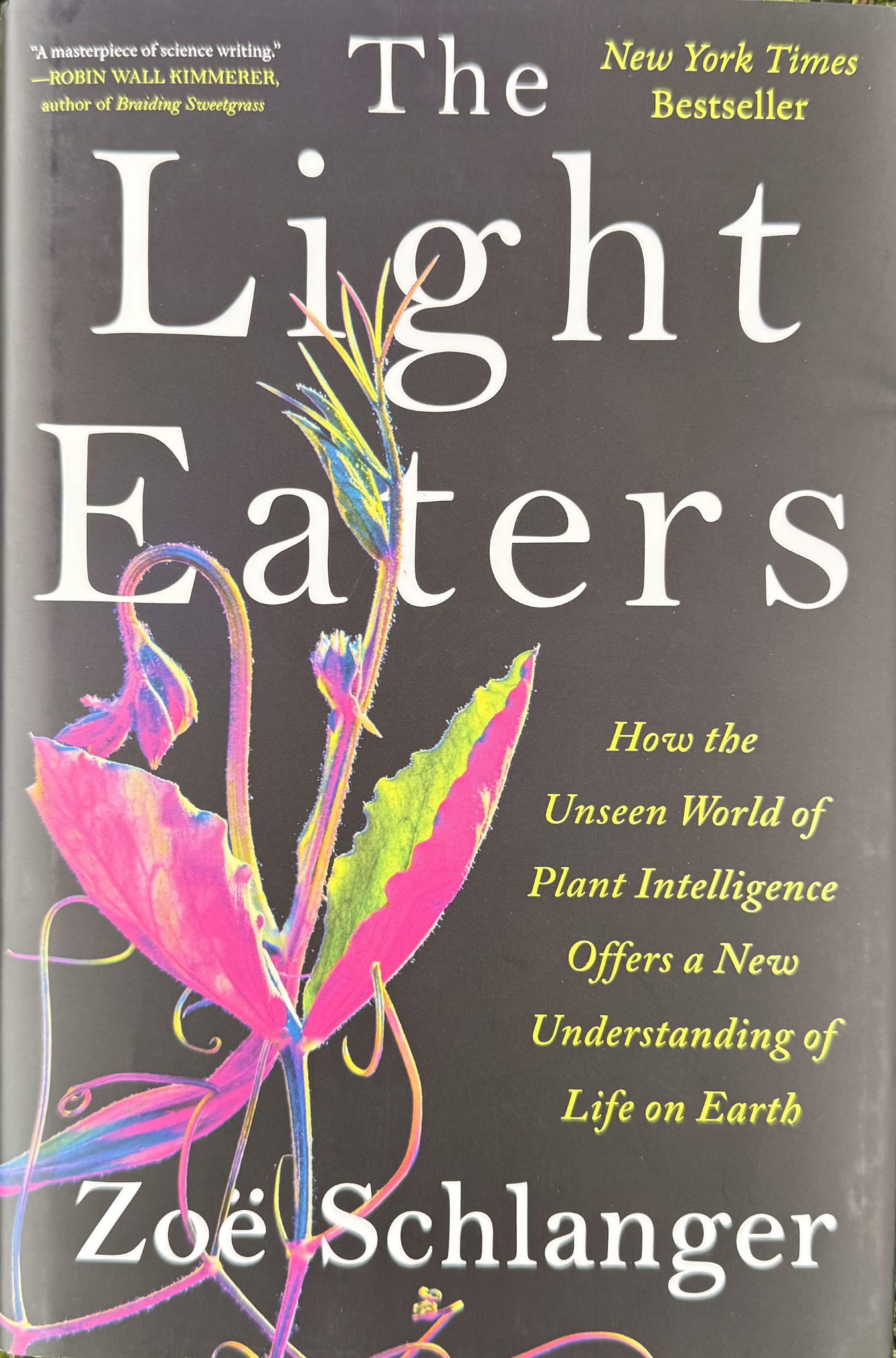
If you’ve ever wondered if the plants in your garden have a secret life that you don't know about, The Light Eaters, by Zoë Schlanger, a science writer for the Atlantic, brings together the latest science to answer this and many other fascinating questions about the world of plants.
Most of the chapters focus on a particular way in which plants sense the world. There's a chapter, for example, on how plants can "hear". Some plants can perceive the sound vibrations of a predator, like a caterpillar, chewing their leaves, and trigger a defense mechanism in response to those vibrations. Others use their “hearing” not for protection but for reproduction: The beach evening primrose can increase its sweetness within 3 minutes of "hearing" the flight of honeybees nearby and attract them to increase its chances of pollination.
There's an even more fascinating chapter about vision. The Boquila trifoliata, or Chameleon Vine, is a parasitic plant that grows in Chile and that it is able to mimic the physical apperance of its host plant. It's not that the vine, through evolution, ends up looking like its host plant; It is that each individual Chameleon Vine transforms itself to look like its host plant. How can a plant mimic the shape and colors of another if it doesn’t see it? Does this mean that it has some sort of vision? Let that sink in.
Like these, there are fascinating chapters about how plants communicate with each other and even with animals, how they store "memories" to increase their chances of survival and reproduction and how they even have, in some sense, distinct personalities and social lives.
But here's where the book turns on more controversial. Isn’t all this talk of senses, personalities and social lives just a way to anthropomorphize plants? Aren't scientists wrongly using our human mental frameworks to explain plant behavior, in a way seeing more than what is actually there? Schlanger doesn't shy away from these controversial discussions and even turns these criticisms on their head. When we talk about intelligence or consciousness, we tend to think about human intelligence and human consciousness. It is clear that plants don't have those, but this doesn't mean that we shouldn't call them intelligent. If intelligence is understood broadly as the ability to react to the environment and solve problems, plants are by all means "intelligent". Schlanger brilliantly makes this point. Her arguments, however, are much weaker when asking whether plants have "consciousness". Schlanger seems to conflate the two concepts and, if we understand consciousness as the capacity to identify oneself as a separate being and to reflect on that uniqueness, she really doesn’t present any evidence for it.
Schlanger uses her love of plants and her journey researching the book as the common thread to the book. In every chapter there's one or sometimes several stories about her research and sometimes even personal ones. As a nonfiction reader, I generally don't like when authors weave their own anecdotes and personal stories with the science. Schlanger doesn't do it to the point of making the book boring, and many of the stories are entertaining, but some of the chapters would've been better if some of these stories were ommitted.
This is a 265-page book for the lay reader. It’s a good and helpful overview of the science and it’s a good roadmap to continue your exploration on your own. If you love plants, you'll love this book. But even if you are like me and have no particular interest or knowledge about plants, you’ll enjoy it as a great introduction to a whole new world.